
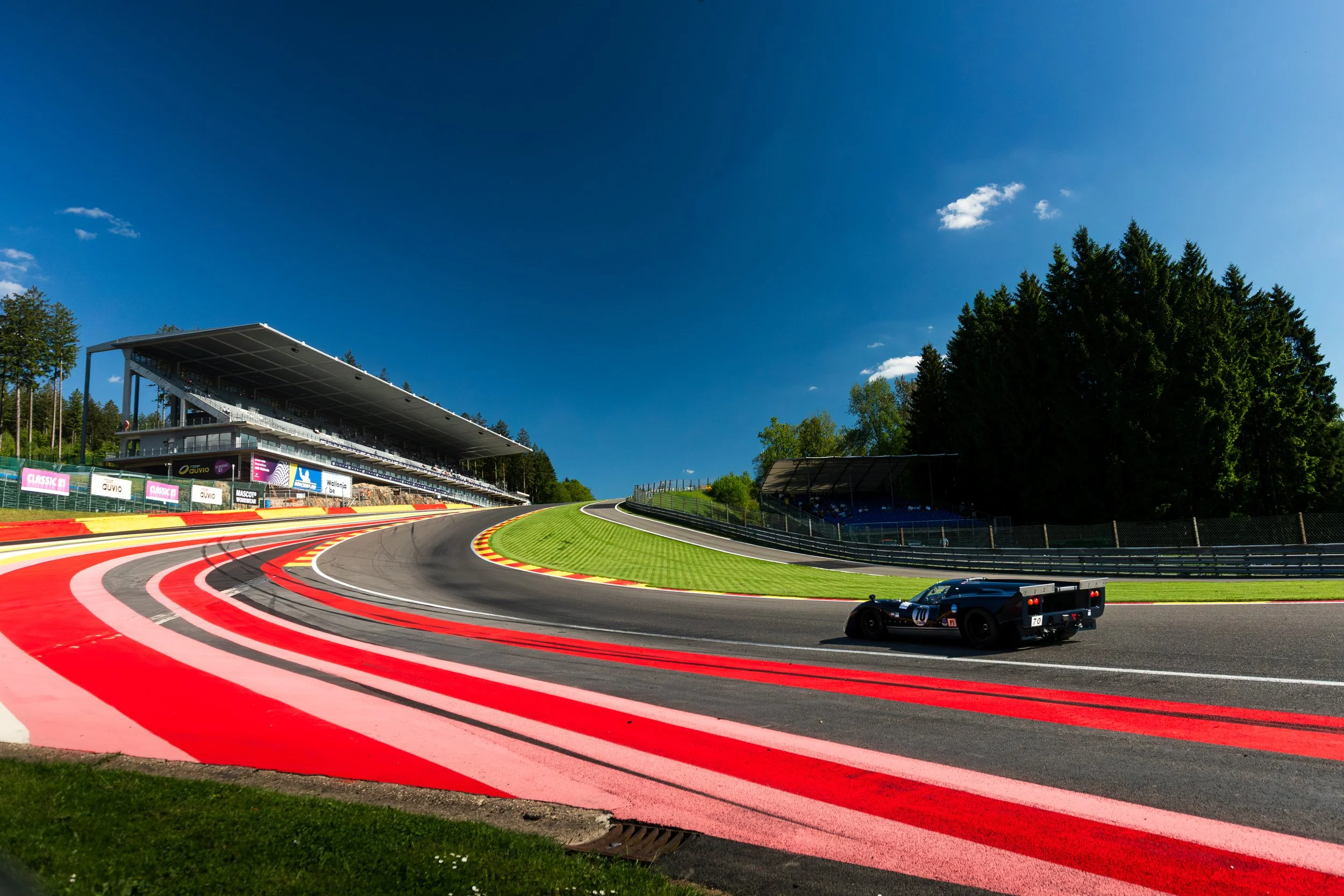
Two Cars. Two Poles. Two Victories.
Spa · May 2026
Legacy Outlaws Racing arrived at Spa-Francorchamps with two Lolas and one shared ambition. They left with something that had never been done before in the team's history: a clean sweep — pole position, fastest lap, and outright victory in both races on the same weekend, across two entirely different cars. Jan Magnussen and Chris Ward drove all four stints. Not a single point of maximum score was dropped.
Weekend Overview
Spa-Francorchamps does not flatter the unprepared. Seven kilometres of undulating Belgian asphalt — Eau Rouge, Raidillon, Blanchimont — demand commitment from the first lap and reward precision across the entirety of sixty minutes. Historic machinery has little margin for error at these speeds, and the Spa Classic draws some of the finest privately entered sports-racing cars in Europe. Winning once here is a result to savour. Winning twice on the same weekend, in two completely different cars, is something else entirely.
Both cars carried an additional handicap that shaped every strategic decision across the weekend. Jan Magnussen holds an FIA Elite driver rating — the highest classification in historic motorsport — which mandates an additional twenty seconds of pit stop time in every race he enters. With Magnussen sharing both cars with Chris Ward, every pit stop in every race at Spa cost the team twenty seconds they would not have spent otherwise. Both victories were achieved despite this, not because of any strategic advantage.
There was also the small matter of a missing seat insert. Magnussen’s custom moulded seat went missing in the pits at the end of qualifying, and the frantic search was on! The team prowled the CER pits, to no avail. The worry continued into the evening until they reached Ducktail Media, who reviewed onboard footage frame by frame to establish where it had last been seen. Clues were found, and the inadvertant transportation to a paddock on the other side of the tunnel was unravelled, and the seat collected in time. The race started on schedule.
CER2 · Lola T292
Qualifying
The T292 qualified on overall pole position in a mixed thirty-two car field that included larger 3-litre engined machinery — cars with significantly more power, on paper, and in reality, including some housing period Formula 1 engines. Magnussen set the fastest lap benchmark at 2:22.500. Ward followed at 2:23.592. The combined average of 2:23.046 placed the car first overall, ahead of every prototype and GT car in the field regardless of engine capacity. For a sub-two litre car running a Cosworth BDG, it was a statement.
The Race
Ward took the start. The T292 was swamped off the line and dropped to fifth before the first corner sequence was complete. By lap two he was back to third. By lap four, second. By lap five, the lead. The recovery had taken less than thirteen minutes of racing.
Ward pitted at the scheduled window. The mandatory Elite penalty added twenty seconds to the stop. Magnussen took over and the T292 rejoined ninth. Magnussen focused on his special mantra, taking responsibility for overcoming the penalty his heritage incurred..
The pit board carried a single instruction: Push.
And he did: Through the field, lap by lap, Magnussen rebuilt the advantage that the penalty had erased. A full course yellow speeding penalty was applied to the race leader and a number of other cars — a thirty second post-race time penalty followed. The gap Magnussen needed to close was thirty-nine seconds. He closed it, and then some, making the decisive overtake around the outside at Blanchimont — one of the fastest corners in European motorsport. In CER racing, as in period, there is no radio communication with the car - it’s all from the pits to the driver by pitboard - so there was no way to let Magnussen know about the leader’s penalty and the fact that although behind the apparent leader, he had in fact moved up to P1. The pit crew had no way of telling he was P1 without confusing him, as he continued to reel in the car he thought was in front. So he just went for it. The T292 won by one minute and five seconds. Magnussen's fastest lap of 2:24.614 on lap twenty was the quickest in the race.
A sub-two litre prototype, running a two-litre Cosworth BDG, had beaten every other 2-litre car, every three-litre F1-engined car, every Group 5 GT car, and every menacing Porsche 935 in the field to finish first overall. The nearest 3-litre finisher was over a minute behind.
CER1 · Lola T70 MkIIIB
Qualifying and the Night That Followed
Jan set the CER1 pole benchmark at 2:28.540 on the opening day. During Chris's subsequent qualifying run, a wishbone failed. The car limped back to the garage with serious suspension damage and a race the following morning.
What followed was a collective effort that said something about what historic motorsport, at its best, actually is. DHG Racing, Wolfe Racing, Pegasus Racing, Team Leo, and Riedling Mouser all contributed time, expertise, and parts through the night. Rob Bicknell and Chris Beck led the rebuild. By morning, the T70 was ready — in inverted commas, as you will see.
The Tyre Story
The spec tyres at this level are supplied by Avon. In 2024, following Avon's acquisition by Nova Motorsport, production moved from the UK to Portugal — a fact that had already introduced itself painfully at the Silverstone Classic in 2025. The car came out of qualifying there looking strong, but in the race it was almost unmanageable. Jan and Chris did everything right, but something was clearly off.
The answer emerged the following Tuesday during post-race teardown, when Rob spotted that one tyre carried a tiny yellow barcode while the other three had white barcodes. Research confirmed what that meant: three UK-manufactured tyres and one Portuguese one. The Portuguese tyre differed in two measurable ways — Shore A hardness and circumference. Small differences. Significant consequences.
Standard procedure is to mark the tyre from the rim, confirming correct positioning and preventing rotation. After the short practice session at Spa, some tyres had rotated nearly ninety degrees. Both Jan and Chris reported a noticeable vibration under load. The car was stripped and inspected — nothing obvious was found. The wheels went to the tyre facility to be checked, reseated, and rebalanced. New alignment marks were drawn. Fingers were crossed.
No such luck. Jan put in an impressive qualifying lap, but coming in to hand over to Chris, he noted the vibration was back — and the tyres had rotated again. Chris went out regardless. The combined average of both drivers determines grid position, so his laps were not optional. He posted a very respectable time before a major failure approaching the pits forced him to nurse the car home. That is when the engineers found the wishbone: sheared clean through at a critical weld point, in two pieces.
The cause was now clear. The slight difference in circumference between the Portuguese and UK tyres was sufficient to allow rotation under load. Other competitors had seen minor rotation; for the T70, it was near race-ending. Several of the teams who helped that night understood exactly what had happened — and showed up anyway.
The Race
Chris took the start. The rebuilt T70 rolled out of the garage and onto the Spa grid carrying the efforts of five teams and a sleepless night. Whatever nerves existed in the Legacy Outlaws garage, they didn't show on track — Chris built a lead of over four seconds in the opening laps, pulling away cleanly from the field.
Then the full course yellow appeared, precisely as the pit window opened. The timing was perfect. Chris pitted with roughly twenty-five seconds in hand. Jan climbed in.
There was a problem. Chris reported significant vibration during the driver change — the tyres had been rotating again. The team knew what it meant. Jan knew what it meant.
Magnussen got in anyway.
He emerged from the pits in second, behind Armand Mille. Within a handful of laps he had reclaimed the lead and begun to pull away. The Elite penalty had been absorbed during the stop. The vibration was managed. The T70 crossed the line 14.744 seconds ahead of Mille, with David Hart and Olivier Hart of DHG Racing — one of the teams that had helped the Outlaws in rebuilding the car — completing the podium in third.
Chris Ward's fastest lap of 2:29.015 on lap three had been set in the opening stint, before the vibration worsened. It stood as the quickest lap of the race.
The Wider Picture
Two races. Two poles. Two fastest laps. Two victories. The mathematics are clean, but they don't fully capture what the weekend meant. Legacy Outlaws Racing ran two entirely different cars — a 5-litre Chevrolet V8 prototype and a 2-litre Cosworth BDG sports-racer — in two separate races on the same day, and won both. The same two drivers shared every kilometre of it.
The T292 result deserves its own moment of reflection. A sub-two litre car, in a class defined by its engine displacement disadvantage, qualified overall pole in a thirty-two car mixed field and won outright against machinery with significantly more power. The nearest three-litre finisher crossed the line over a minute behind. That is not a class win dressed up as something more. That is a genuinely faster car, driven better, on the day that mattered.
The T70 victory carried its own weight. The overnight rebuild — made possible only by the generosity of rival teams — produced a car that won despite a known mechanical compromise. That DHG Racing finished third in the same race, in the car they helped fix, is the kind of detail that makes historic motorsport worth following.
DaBoss was characteristically understated. The team was not.
Both cars now carry success penalties into the next round. The Grand Prix de l'Age d'Or at Dijon-Prenois runs from 5 to 7 June — one week away. The T292 and T70 will start from further back than their pace deserves. That, at Spa, turned out not to matter at all.
Results & Data
CER2 · Lola T292
1st · Legacy Outlaws Racing — Lola T292 HU40 #70 — Magnussen / Ward · P−2L · 21 laps · Winner · Pole + Fastest Lap (Magnussen 2:24.614, Lap 20)
2nd · Stéphane Nguyen — Lola T282 · P+2L · 21 laps · +1:05.000 · 3-litre
3rd · TOJ SC304 · P+2L · 3-litre
CER1 · Lola T70 MkIIIB
1st · Legacy Outlaws Racing — Lola T70 MkIIIB #70 — Ward / Magnussen · P+2L · 21 laps · Winner · Pole (Magnussen 2:28.540) + Fastest Lap (Ward 2:29.015, Lap 3)
2nd · Armand Mille #35 — Lola T70 MkIIIB · P+2L · +14.744s
3rd · David Hart / Olivier Hart #42 — Lola T70 MkIIIB Spyder (1969) · P+2L · +40.858s · DHG Racing
Extended Coverage
Both races are available in full via the Peter Auto Day 2 live stream. Links below jump directly to each race start.